Speed isn't the pitch. It's what breaks first.
Everyone wants to hire faster. Almost nothing in a typical hiring stack was built for it. Here's where the time actually goes.
Before you read
3 min readMost hiring decisions are not slow. Sit in on a real debrief and you'll usually hear a yes or no inside a few minutes. A hiring manager who has met the person, read the notes, and talked it through with the team rarely needs long to decide. That part of hiring works fine. It always has.
The slowness happens after the decision, not during it. Someone has to turn a "yes, let's move forward" into an actual next step. That means finding a free slot on two or three calendars. Writing an email that doesn't sound like a form letter. Waiting for a reply. Following up when there isn't one. Copying a status into a spreadsheet so the next person in the loop knows where things stand. None of this is hard. All of it takes time, and every step is a place the thread can drop.
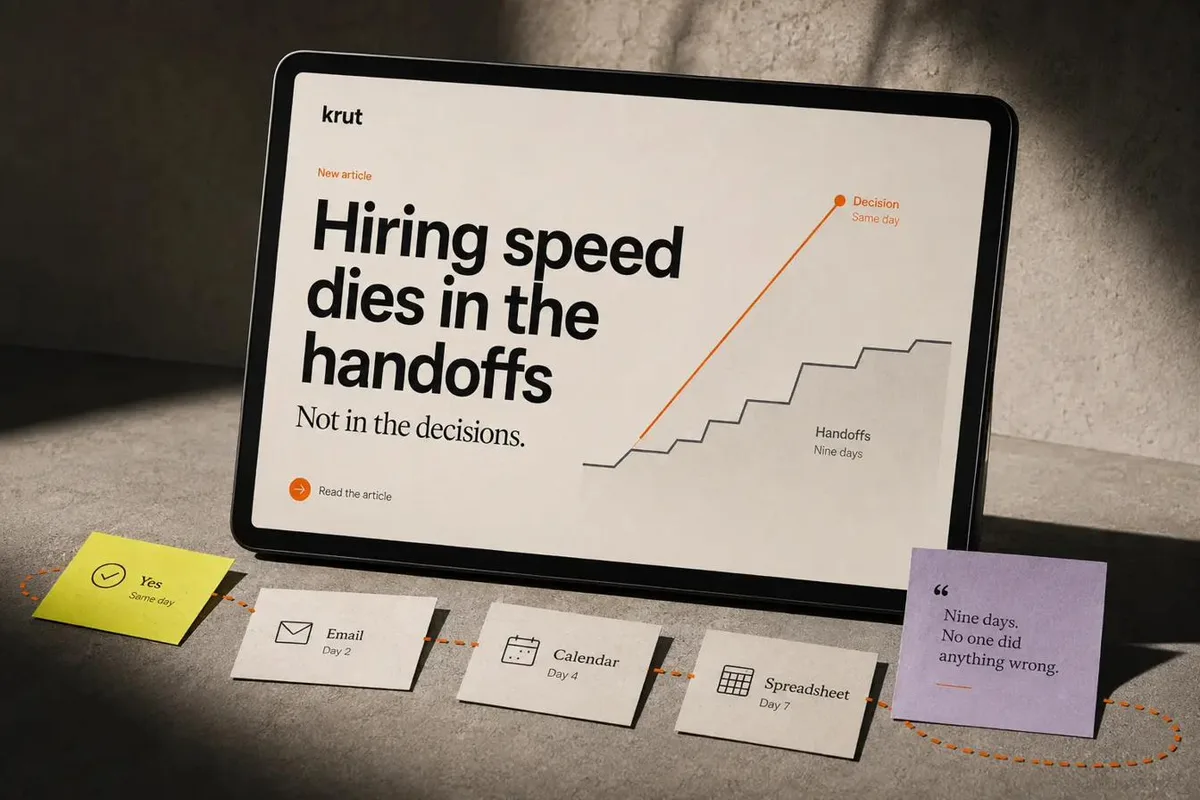
Picture the ordinary version of this: a hiring manager says yes in the room on a Tuesday. By the following Thursday, nobody has actually scheduled anything. Not because anyone dropped the ball on purpose. The invite went out, got a "can we do next week instead," sat in an inbox over the weekend, and by the time someone circled back the candidate had accepted somewhere else. The manager was fast. The nine days between the yes and the calendar invite were not.
Nine days, and nobody did anything wrong.
This is the part of hiring nobody puts on a scorecard. Everyone measures time to hire as one big number, then tries to speed up the interviews, cut a round, rush the debrief. But the interviews were never the bottleneck. The bottleneck is the handoff between the decision and the next tool that has to pick it up. Email to calendar. Calendar to spreadsheet. Spreadsheet to a Slack message asking if anyone's heard back. Each handoff is a seam, and seams are where things wait.
The usual fix makes this worse. A slow stage gets a new tool bolted onto it: a scheduling link here, a Slack integration there, a second spreadsheet to track the first one. Each addition solves its own narrow problem and creates a new handoff at the same time. The stack gets longer. The number of places a candidate can silently wait for someone to notice gets longer with it.
Speed, in other words, is not a personality trait. It's not about hiring managers who reply faster or recruiters who type quicker. It's a property of the system those people are working inside. A fast decision maker trapped in a slow handoff chain will still lose candidates to a company that simply had fewer seams between "we like them" and "here's your start date."
This is the actual reason we're building Krut the way we are. Not because speed makes a good tagline. Because it's the first thing that breaks when a hiring process is stitched together out of separate tools that were never meant to talk to each other. Screening, scheduling, and messaging living in one place doesn't remove the thinking. It removes the seams.
None of this means hiring should feel rushed. A fast process and a careless one are not the same thing, and conflating them is how you end up hiring quickly for the wrong reasons. The goal isn't to shorten the parts that deserve real attention. It's to stop losing days to the parts that never needed to take that long in the first place.
If you think the decision is the slow part, time it. Then time everything that happens after it. The second number is the one worth fixing.